Seeking Sustainability

The greening of our nature's masterpiece.

Thursday, October 28, 2010

Becoming a Vegetarian

"The beef industry has contributed to more American deaths than all the wars of this century, all natural disasters, and all automobile accidents combined.  If beef is your idea of 'real food for real people' you'd better live real close to a real good hospital." - Neal Barnard

Ever since reading Fast Food Nation by Eric Schlosser, I've been uneasy about eating meat. I'm glad I read it, because it started me thinking about buying local or humane raised/slaughtered meat. Sadly that only lasted as long as my wife and I were both earning income. The sad reality is that it's too expensive to know your meat and buy it from trusted, humane sources, and we can't afford to do it anymore. One weekend recently I was volunteering at D Acres recording video and Josh Trought said something that really imprinted upon me: when it comes to beef, the meat industry will feed 100 people worth of grain to each cow to get 10 people worth of beef to eat, so why not just eat the grain ourselves and feed more people?

On top of this, I've noticed lately just how uneasy I am with the flavor, smell, and heavy feeling in my tummy of cooked meat, especially red meat. Just a couple of days ago I cooked some maple bacon we received from the food pantry. It was the typical maple bacon from the grocery store that I would have normally loved before, but the taste, texture, grease, and smell... it was disgusting. I could smell it in our home even still this morning and it was literally making me queasy. I'm not sure how or why this started happening, but I've been far more mindful of it lately and intent on doing something about it.

And so I've been working toward a plant-based diet, although I think I will still eat eggs and dairy, at least for now. I'm not quite ready for vegan. I occasionally eat eggs for breakfast, but most mornings I have taken to eating a delicious chocolate peanut butter oatmeal, the recipe for which I found on the blog (never home)maker, which I highly recommend. I've also been working up to this little by little, starting with Meatless Monday.

I would certainly appreciate any and all advice or suggestions that anyone experienced with a plant-based diet could offer.

Thursday, September 23, 2010

On Why I Fast for my Birthday

Since invariably it comes up from year to year, I wanted to resurrect part of a former post I made on another blog and expand upon why I fast for my birthday.

For the past few years on my birthday I have fasted as a spiritual commitment. I believe that we are all related, every living thing, and that we must all have a certain amount of respect for each other and our place on this Earth. I know that what I eat was once living and has sacrificed its life so that I may live. Life feeds on life. To celebrate another year of life I sacrifice that sustenance to give other living things a little more time and to show my respect and gratitude for that sacrifice.

 So what does this have to do with my efforts to live more sustainably? Fasting for one day a year hardly puts a dent in consumerist tendencies. What this spiritual experience does for me, and ultimately for my attempt to live more sustainable, is serve as a reminder to be grateful, but also a reminder that what I consume had to come from somewhere. For this food to come to me, someone else had to sacrifice. What I have eaten is not only no longer available as food for someone else, but is life no longer lived, and overconsumption leads to senseless taking of life when I could get by on far less. While I still struggle with unsustainable eating habits, I feel this reminder is so important to me to keep me grounded in respect for all my relations (not just human or animal, but all life and creation) and focused on how I can reduce what I consume to spread the wealth and only take what I need so others may do the same.

I'd like to share a Lakota prayer that really inspires me and fits this day so appropriately.

Aho Mitakuye Oyasin....All my relations. I honor you in this circle of life with me today. I am grateful for this opportunity to acknowledge you in this prayer....
To the Creator, for the ultimate gift of life, I thank you.
To the mineral nation that has built and maintained my bones and all foundations of life experience, I thank you.
To the plant nation that sustains my organs and body and gives me healing herbs for sickness, I thank you.
To the animal nation that feeds me from your own flesh and offers your loyal companionship in this walk of life, I thank you.
To the human nation that shares my path as a soul upon the sacred wheel of Earthly life, I thank you.
To the Spirit nation that guides me invisibly through the ups and downs of life and for carrying the torch of light through the Ages. I thank you.
To the Four Winds of Change and Growth, I thank you.
You are all my relations, my relatives, without whom I would not live. We are in the circle of life together, co-existing, co-dependent, co-creating our destiny. One, not more important than the other. One nation evolving from the other and yet each dependent upon the one above and the one below. All of us a part of the Great Mystery.
Thank you for this Life.


I was touched by Bill Moyer's call to include a spiritual perspective in our activism, read from his book Doing Democracy this year on the eve of my birthday and the beginning of my fast. In his book, Moyer says:

"Spirit refers to the strong inner urge for meaning in our lives, an urge that involves a deep, positive connection with each other, the planet, and an evolving universe. Compassion, kindness, love, equality, support, and caring, therefore, are qualities of spirit. They bring us back in touch with our true nature. When we experience these qualities we tend to feel more fulfilled, joyful, energized, and happy. These are also the qualities of the peaceful model that we seek." (p. 198)  

 I hope my spirituality can inform my activism well into the future, and that I will heed the lessons I learn from it in daily life and effecting change.

Wednesday, September 1, 2010

Small Round Cordwood Home

“There is a magic in that little world, home; it is a mystic circle that surrounds comforts and virtues never known beyond its hallowed limits” - Robert Southeby

While I've been busy with lots of reading now that graduate classes have started in earnest, we've both been reading Cordwood Building: The State Of The Art, loaned to us by our wonderful neighbors. We've given a lot of consideration to more natural construction styles versus traditional stick-built. We like straw bale, cob, and cordwood construction, but to us it seems cordwood would be most suitable to our northern New England climate.

We've also been considering shape. I really like how Cordwood Building pointed out efficiency of vertical wall square footage versus footprint, with a perfect circle being the most efficient (less vertical wall for the most square footage), with a perfect square being next most efficient and the most efficient rectangular footprint. For us we have spiritual reasons for gravitating toward a round house, as well.

At this point it looks like we're going for a round house, but we might make a quarter of it square, essentially ending up with a teardrop shaped house. We think this has some cool potential for layout options and maximizing square footage and minimizing vertical wall. Our footprint is coming out around 300sf with a loft, giving us space for a small bedroom for our son and a tiny bathroom, plus a combined living/kitchen space and the loft for our sleeping quarters. I would really like to see us build the loft in a way that we can leave some or all of the living area open cathedral-style to give more vertical space and imply a bigger area than it actually is, which really is key to tiny housing.

While we are nowhere near being ready to build anything, it's nice to design and plan now so we can work toward achieving this goal in a few years. If we approach this right, including buying appropriate, buildable land from somewhere like craigslist or eBay real inexpensive, we could potentially have our own very eco-friendly, sustainable home that we own mortgage-free and for a fraction of what traditional homeowners spend on purchasing a home. You can't really get a much better investment than that!

Friday, August 27, 2010

Making a Recycled Notebook

"We may recycle newspapers and glass and take proper satisfaction for doing so, but we remain caught in a web of spiritual assumptions about success and consumption, progress and waste that effectively undermine and trivialize our efforts to escape."  - William H. Becker

In preparation for graduate school, I decided to not only reuse some of my partially filled notebooks from my undergraduate days, but also use some one-sided printed paper to make a recycled notebook. I used a cereal box from my recycling bin to make the cover, three-hole punched everything, and bound it with ribbon. Instead of leaving the cover as the front of the cereal box, I used a bunch of old stickers we had lying around just waiting for a use. The end result is a thick notebook of mostly one-sided sheets of paper that didn't cost me any money beyond stuff I already had as waste from other purposes or as leftover stuff from years ago, and it reduced how much we would be throwing away or recycling by reusing instead. Have I mentioned I love finding ways to use the waste stream as a resource?

The cover in all its cheesy glory. At least it isn't an advertisement for a brand of cereal!

As you can see, the face of each sheet is blank and ready for writing. Why recycle this sheet of paper when there's still more room for words and pictures?
And while I'm at school, I have the added benefit of some pages reminding me of my budget season deadlines so I can get my department budget figured out and submitted on time. Worry not, they gave me two copies.
While I'm at it, I can use some down time to brush up on biology.
Or, if I am caught up on my studies and have some free time and my guitar with me, I could play a jazz standard.
If I'm super bored I can play this little U.S. history trivia challenge on the back of the notebook, which coincidentally enough (well, not really coincidentally) came from the back of the cereal box. I figured it was fitting since some of my course work will involve political strategy.

Monday, August 16, 2010

Have You Got Anything Without Spam?

“It is not the quantity of the meat, but the cheerfulness of the guests, which makes the feast” - Edward Hyde

I realized a couple of days ago that I was remiss in not including a link to Meatless Monday in my post of links, so I have corrected this. I also figured now would be a great time to talk about some of our pursuits to cut down on meat.

We like to eat meat. Unfortunately we like to eat too much meat, which is pretty much typical of the average American's diet. This is one area of our unsustainable eating habits that we identified a while back and decided to work on by finding ways to have meatless meals and meatless days. That's not to say we want to go vegetarian or even vegan, but we recognize that meat production has a substantial negative impact on our environment so we want to decrease how much we eat and work toward quality (local farms that practice safe, sanitary, humane, eco-friendly meat production) over quantity (hey, the supermarket has a family pack of factory produced steaks on sale! let's get that for dinner!).

We have a lot of beans in various forms: dry, canned (not by choice, but we get a lot of them from the food pantry and WIC right now during these hard economic times), refried. The thing to be mindful of is whether our source of protein is complete, meaning it contains all of the essential amino acids. Meat by default is complete, but we can also find some plant sources for complete protein (soy, buckwheat, quinoa) or combine foods (beans and rice, beans and grains, beans and corn, beans and nuts, beans and pasta, etc.) to get a complete protein source. Hummus is a great complete protein so we've started experimenting with making our own hummus. We've also been eating casseroles made with beans and rice, and adding beans to pasta dishes.

For lunches we use cheese in place of meats, especially with salads. We have also added nuts to salads or made bean dishes for lunch if we're doing something different for dinner. We've learned through experience not to do everything bean because it burns you out on them real quick. I enjoy eggs, so I eat eggs for breakfast just about every day anyway (usually an omelet with veggies and maybe some cheese). Kathy can't do eggs because they make her sick, so we usually try to find something for her that is meatless and eggless. We don't have as much problem with eggs and cheese because you don't have to raise a bunch of cows or chickens and slaughter them to get these things. You can get by on fewer animals and go back to them again and again to get the food.

The key is to make sure we find a variety of ways to find complete proteins and not overdo one particular food. In addition, we're looking at meat as a "sprinkling" additive with our food instead of the main portion of our meal. This reduces our meat consumption but still keeps us healthy and getting some meat which we enjoy, thus reducing our carbon footprint. We could go vegetarian, and perhaps someday we will, but even finding a balance is much more sustainable than our habitual overconsumption of meat.

Monday, August 9, 2010

Goals and Rules and Needs, Oh My!

“First, have a definite, clear practical ideal; a goal, an objective. Second, have the necessary means to achieve your ends; wisdom, money, materials, and methods. Third, adjust all your means to that end.” - Aristotle

We've done some short and long term goal setting, as well as come up with some rules for our 100 Thing Challenge which are pretty much modified from David Bruno's original rules for himself. We also did some needs/wants listing for our eventual tiny/small house. Here's what we came up with...

Goals: We came up with some short-term and long-term goals for living more sustainable so we have intermediate steps we can take to get us toward the bigger goals. Admittedly some of these are wishy-washy and need to be more definite, especially the goals that say "set this goal."

Short Term Goals
  • Develop rules for our 100 Thing Challenge and follow through. Reduce to 100 things each by January 1, 2011 and live with 100 things until January 1, 2012.
  • Get bikes with bike trailer(s).
  • Reuse as much as possible (use the waste stream as a resource).
  • Buy or make a composter.
  • Set specific weight loss goals for the winter and determine the dietary and fitness means to accomplish them.
  • Pay off the truck.
  • Reduce our dishes and cookware to as minimal as possible.
Long Term Goal
  • Live in a small house or apartment (250 - 350 square feet).
  • Live within bike/walk distance of work, school, food, etc.
  • Become locavores: shop locally for locally grown/made food, clothing, shoes, etc.
  • Lose weight and get in shape. Goal weight 150-180 pounds.
  • Get a very fuel efficient vehicle or have no car at all.
 100 Thing Challenge: We decided for the most part to each follow David Bruno's original 100TC rules with some modifications.
  • We would also count one library of books as one item, but we would be specific in deciding on one bookcase to keep and that is the library for books, magazines, photo albums, and physical media of music and movies.
  • Memorabilia would count as one item if it could fit into one small bin.
  • Certain items for hygiene and/or convenience sake must be grouped into single items. Underwear and bras are one item. Socks and hosiery are one item. I will allow myself to use my travel makeup kit to hold enough makeup for regular use and count it as one item. A set of regularly used personal hygiene items will count as one item (toothbrush, hair brush, nail clippers, etc). I will reduce my tools to the bare essentials and what I can fit into a small or moderate sized tool box is one item.
We decided that handling gifts and new items would work as in David Bruno's original rules.

Tiny Home Wants/Needs: This is still distant thinking, but if we're going to start planning for a long-term goal of living in a tiny/small home, we have to figure out what we want and need from our home. These lists are still in the works, but what we have so far...

Wants
  • Composting toilet
  • Greywater recycling system
  • Solar and/or wind power
  • Solar hot water
Needs
  • Ian's own private space
  • Kitchen
  • Bathroom
  • Sleeping space
  • Common living space

Saturday, August 7, 2010

Tiny Houses and Small Houses

“Any intelligent fool can make things bigger, more complex, and more violent. It takes a touch of genius – and a lot of courage – to move in the opposite direction.” – E.F. Schumacker

We've been really getting into trying to design a tiny house or small house for our family and determining just how small we can go. While our son's privacy concerns will increase our space needs as he gets older, for now we feel we can get down to a very small size, for example around 172 square feet. We were inspired by the Popomo design at Tumbleweed Tiny House Company.
The Popomo layout, which has a bedroom for two people.
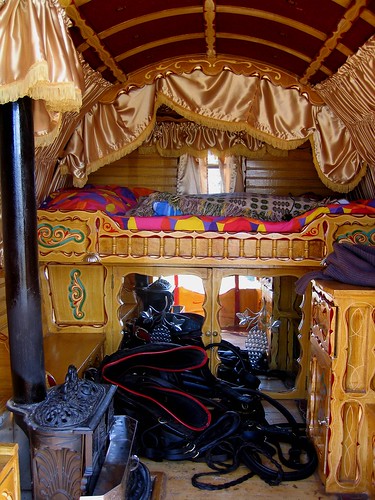
This design is for two people, but what if we got creative with sleeping arrangements? What if we took some inspiration from the Romani vardo as suggested by Kathy, where we combine a bunk with storage space? This led us to view the single bedroom that occupied the space from floor to ceiling as wasted vertical space that could more efficiently sleep three people in a bunk-and-cubbies configuration that also gave us some built-in storage for clothes.
An example of a vardo bunk.
What I came up with for a design isn't quite as ornate or old world, but still very functional and fitting for the modern and right-angled design of the Popomo. The design below incorporates a top bunk that would give Kathy and me essentially a full bed with a window. Ian would have the bottom bunk, which isn't as deep but also gives him a set of shelves and cubbies for his clothes and toys. We're contemplating adding a set of cubbies and shelves along the head of the upper bunk for us since it's much longer than needed for sleeping and would give us storage options, too. This way we economize on the sleeping space and fit three of us comfortably in the space originally designed for two people.
On the left is a view facing the bunks. The right is a top-down view, which has a dotted line showing where the lower cubbies and shelves are in the back of the lower bunk.
When Ian gets older and needs his own space, we're looking at upgrading to a small house design like the Harbinger. I'm also a fan of shipping container houses (check out specifically the Ecopod, the Port-A-Bach, and the All Terrain Cabin), but Kathy is having a harder time getting into them. I see them as having great potential for a greenhouse or living roof stacked on top. The greenhouse gets us a sloped roof essential for New England but also gives us a living roof that we both want to use for extended growing seasons or year-round growing of some foods.

Saturday, July 31, 2010

Donating Our Clothes and Sharing Our Thoughts

"Do not trouble yourself much to get new things, whether clothes or friends… Sell your clothes and keep your thoughts." - Henry David Thoreau

Today we donated five more bags of clothing and shoes. This follows on our previous donation of five bags of clothing. It's astounding how when these clothes were in our closet and on our shelves they didn't seem like so much. It's a very stark realization that we donated ten trash bags filled with clothes (and a couple pairs of shoes each) and we still have some more clothes recently given to us to go through and the lot that we kept. Thankfully I can now say I have distilled my clothing down to enough to fit comfortably in my half of our small closet (including t-shirts, but not including underwear) with room to spare. That also includes the three or so outfits of each of two sizes smaller so I'm prepared for the weight I'll be losing over the rest of summer and autumn. Clothing still takes up more than half of my list of 100 things, but I hope to lose enough weight to get rid of at least the current stock, if not also the next size down, by January 1.

Five bags of donated clothes compared to the blue and yellow laundry bags, which contain one week of laundry for our family of three and three blankets and a bathrobe that we've put off washing for a while.


The more we work toward our goal of 100 things each (plus 100 shared family items at most), the more liberating it feels and the less reluctant I am to get rid of stuff. I can already see and feel the difference in our home, and how less cluttered it becomes with each donation. I can't wait until we can have a big yard sale!

Wednesday, July 28, 2010

Making Our Lists, Checking Them Thrice

We're still working on overall goal setting, but we have a decent set of short and long term goals to start. I'll post those later when I have them handy. In the meantime, we're working on our lists for the 100 Thing Challenge. We're giving ourselves until January 1, 2011, which is roughly six months from our decision to do this, to get down to 100 things each.

So far I've managed to get rid of five trash bags full of clothes and keep those which are best suited for work, school, and down time. This is after I already purged a bunch of clothes. I had been holding on to a lot of clothes in the hopes that they would fit me again, but really in the meantime there are other people who could use those clothes and I can find clothes when I lose weight. This time around I kept a couple outfits of each size lower so I have some backup as I will be losing weight soon, but not much. Even still my list of 100 things is still half full with clothes alone, so I need to lose weight before January 1 enough to get rid of at least the current stuff, possibly the next size down, too.

In other news, we've been talking about just how small we could live, and the possibility of getting the Fencl model (130 sf) and getting creative with use of space, such as when Ian is older and needs privacy giving him the loft and building a compartment to store a roll-out futon mattress in the living area for our sleeping needs. If we build it ourselves and find a suitable cheap lot on Craigslist or similar (making sure we check for no quit claim, legal building lot, zoning permits essentially mobile homes/temporary structures/camps, etc.) we could easily save up the money and own our own home without mortgage in four or five years, and it would be very eco-friendly and, should we need to relocate, we could take our home with us.

Tuesday, July 27, 2010

We Have A Bicycle Trailer!

My parents bought us a bicycle trailer for Ian's first birthday! Apparently they also have one of my old bikes in the barn, so my Dad is possibly going to fix it up for us and bring it up to us next weekend. With any luck, within a week, we should be on the road bicycling places instead of driving in a car whenever possible. Thanks Mom and Dad!